


Kovacikia euganea ETS-13: A New Cyanobacterium Discovered in the Euganean Thermal Springs
A research team from the Department of Biology, in collaboration with the Study Center, has recently discovered and characterized Kovacikia euganea ETS-13, a new species of thermophilic cyanobacterium isolated from microbial biofilms present in the mature mud of the Euganean Thermal District.
This microorganism, belonging to the Leptolyngbyaceae family, is capable of growing under extreme conditions, characterized by high temperatures and low light levels, demonstrating exceptional ecological and metabolic flexibility.
Morphological Features and Environmental Adaptation
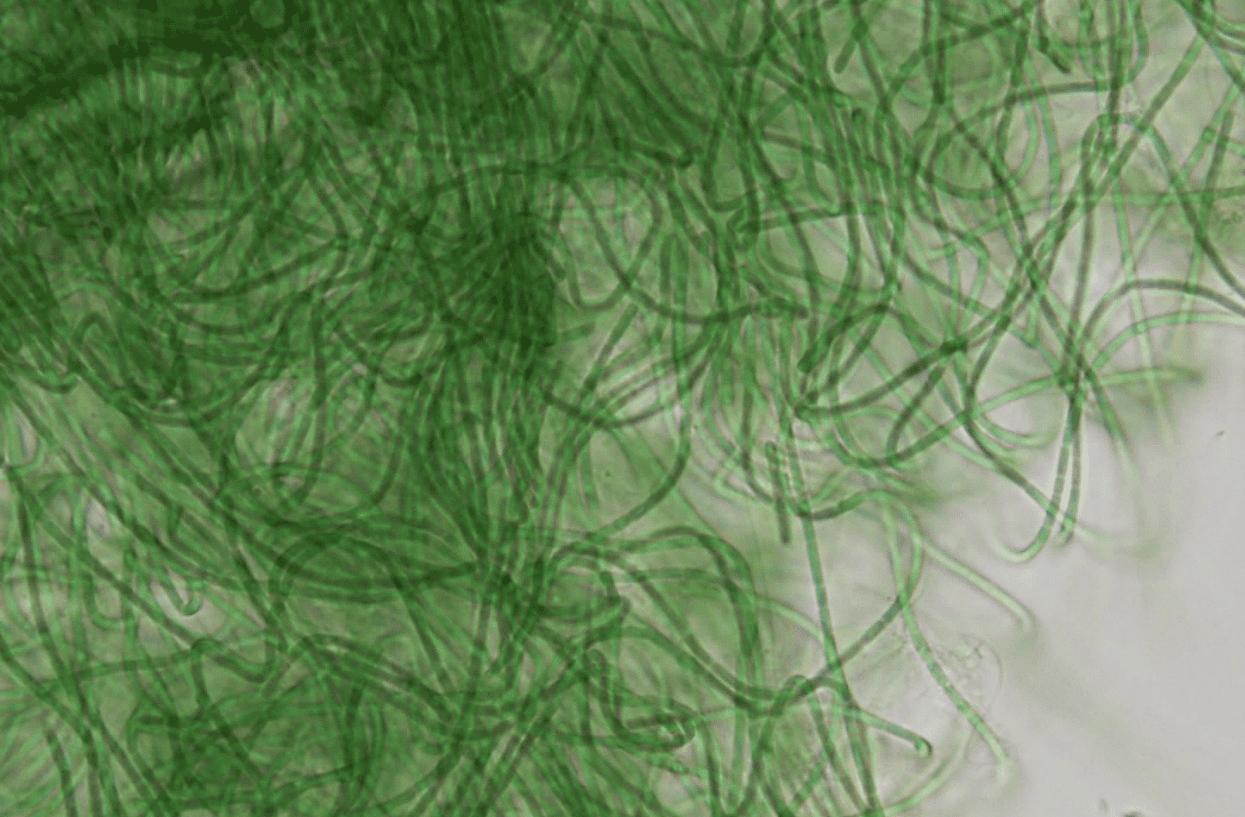
- ETS-13 appears as thin, intertwined filaments capable of forming floating mats on the surface of thermal mud.
- It can grow at temperatures between 45 and 55 °C, with an optimum around 50 °C.
- It survives in low-light environments thanks to its ability to adapt to the filtered light typical of microbial biofilms.
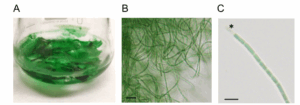
(A) Cultures form dense, compact floating biofilms. (B) Widely intertwined ETS-13 filaments observed under an optical microscope. Scale bar: 10 μm. (C) Filament with elongated cells. The sheath is highlighted (*) at one end. Scale bar: 5 μm.
A Cyanobacterium with Special Photosynthesis: The Role of Chlorophyll f
One of the most fascinating discoveries concerns ETS-13’s ability to produce chlorophyll f, a rare photosynthetic pigment that enables the use of infrared light for photosynthesis.
This process, known as Far-Red Light Photoacclimation (FaRLiP), allows the cyanobacterium to survive even in low visible light conditions, such as in the deeper layers of biofilms.
The presence of this pigment is confirmed by the “shoulder” visible in the absorption spectrum at wavelengths above 700 nm.
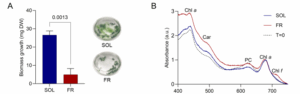
(A) Biomass growth measured as dry weight (DW).
(B) In vivo absorption spectra.
Genetic Analysis and Evolutionary Implications
The genome of ETS-13, analyzed through Next Generation Sequencing (NGS) techniques, revealed:
-
A close phylogenetic relationship with other thermophilic cyanobacteria, especially those of the genus Kovacikia, found in hot environments around the world.
-
The presence of a specific gene cluster associated with infrared photoacclimation (FaRLiP), a trait shared with only a few other known cyanobacteria.
-
The absence of genes associated with cyanotoxin production, suggesting that ETS-13 does not pose a toxicological risk.
Potential Biotechnological Applications
The discovery of Kovacikia euganea ETS-13 could have significant implications in various fields of research and innovation:
-
Sustainable energy: Its ability to harness infrared light for photosynthesis could inspire new technologies for bioenergy production.
-
Medicine and cosmetics: Thermophilic cyanobacteria produce bioactive compounds with potential anti-inflammatory, antioxidant, and antimicrobial properties, useful for pharmaceutical and dermatological applications.
-
Astrobiology: ETS-13’s resistance to extreme conditions could offer insights into the potential for microbial life in extraterrestrial environments, such as the icy moons of Jupiter and Saturn.
The characterization of Kovacikia euganea ETS-13 enriches our understanding of the biodiversity of thermophilic cyanobacteria and their role in extreme ecosystems.
Its discovery not only contributes to our knowledge of photosynthesis evolution but also opens new avenues for the development of innovative technologies in the fields of bioenergy, health, and environmental research.
📖 For further reading, see the full study published in Frontiers in Microbiology!