


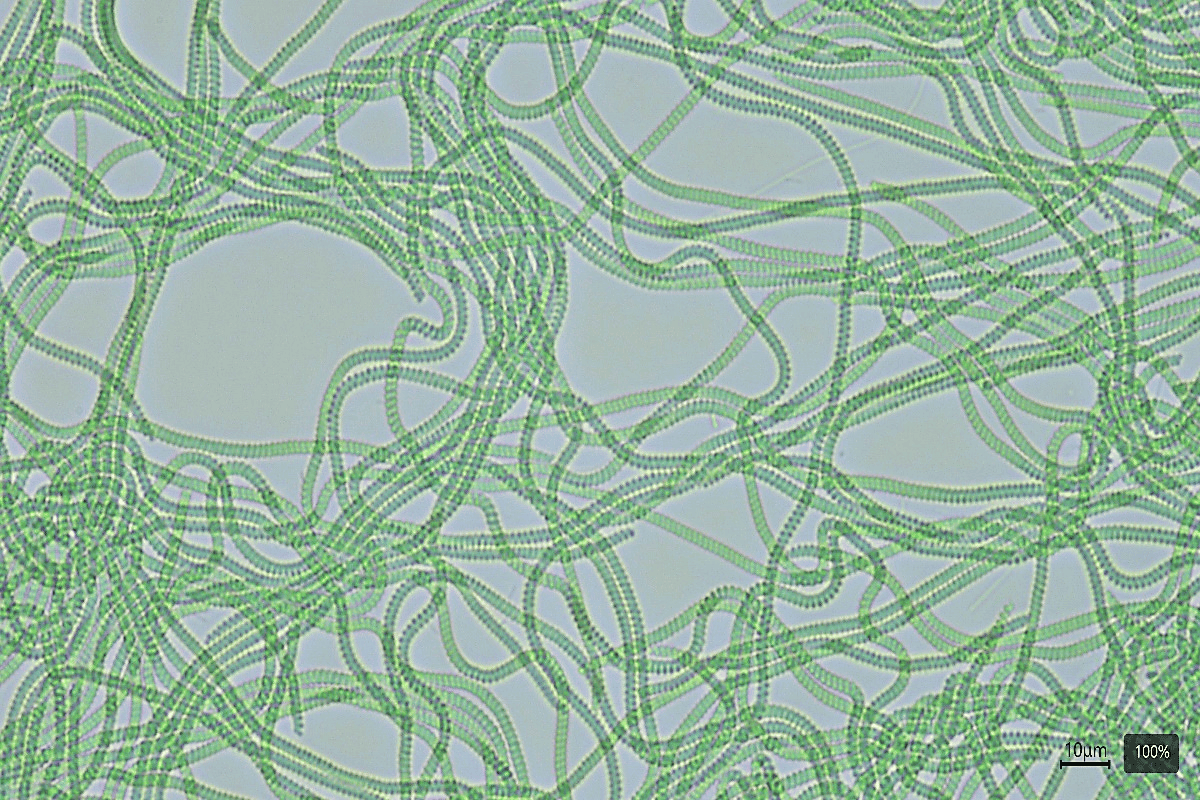
Thermospirulina andreolii ETS-09
Thermospirulina andreolii ETS-09 is a cyanobacterium recently isolated from the biofilms of mature mud in the maturation tanks of the Euganean Thermal District. This new species was described by Moro et al. in 2021 through morphological, biochemical, and phylogenetic analyses.
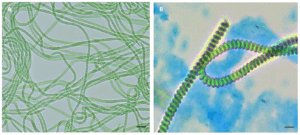
As shown in Figure 1A, ETS-09 consists of long and thin filaments of cells with regular, tight spirals. No clear sheath is visible, but the filaments are surrounded by a rich extracellular polysaccharide matrix (EPS), stained in Figure 1B using Alcian blue.
Genetic analyses revealed a high identity with a species isolated from thermal springs in Greece and close similarity to other thermophilic strains from Greece and Yellowstone National Park, USA. These strains form a group referred to as the Hot Spring Clade, which led to the definition of a new genus: Thermospirulina, with T. andreolii as the representative species. Its genetic sequence (16S rDNA gene) is registered in international databases.
According to recent studies based on next-generation sequencing (Gris et al. 2020; Caichiolo et al. 2024), T. andreolii is widespread in maturing thermal mud and in clays from thermal ponds and wells in the Euganean District. It is particularly abundant at temperatures above 45 °C, which also represents the optimal growth temperature for this species, as confirmed in the PhD dissertation of Dr. Raffaella M. Zampieri.
Currently, Thermospirulina andreolii ETS-09 is cultivated and preserved in the Strain Collection of the Plant Genome Editing and Phenotyping Facility at the Department of Biology of the University of Padua, on behalf of the Pietro d’Abano Thermal Studies Center.
This profile is the result of a long-standing collaboration with the Department of Biology of the University of Padua, and is part of the Digital Archive of the Pietro d’Abano Thermal Studies Center, created with the support of the Municipality of Montegrotto Terme (City Council Resolution No. 121 of 17-07-2025).