


General information
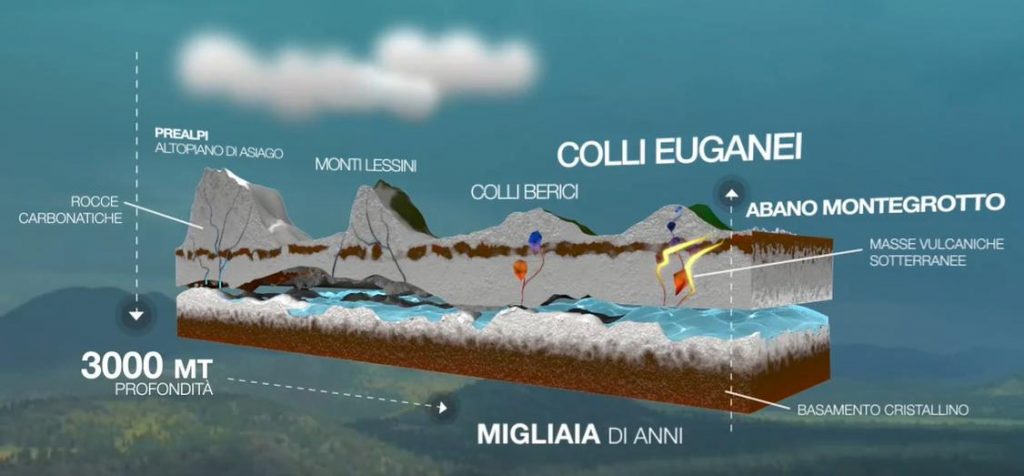
The origin of Euganean thermo-mineral water has long been a source of debate. Recent studies have ascertained an exclusively geothermal circuit pattern that is independent of the volcanism that created the hills and is too ancient to generate an active source of heat.
The presence of thermo-mineral water in the Euganean area is attributed to the obstacle created in depth by the lava masses and to a series of fractures that favor the rising of water, pushed upwards by the hydraulic pressure of the basin below.
The measurements with radioactive materials indicate that it takes at least 50 years, more likely thousands if not tens of thousands of years, for water to flow from its fall zone to the Euganean area.
When water reaches the surface, its salt content is directly proportional to its temperature, which can reach up to 87° C in the hottest wells.
The water is protected by the so-called Homogeneous Hydromineral Basin of the Euganean Hills, identified by the acronym B.I.O.C.E., constituted within the Province of Padua and including the municipalities of Abano Terme, Arquà Petrarca, Baone, Battaglia Terme, Due Carrare, Galzignano Terme, Monselice, Montegrotto Terme, Teolo and Torreglia. The water in this basin has uniform chemical characteristics.
Euganean thermal water, according to the most common and immediate definition based on the variable temperatures, can be defined as hyperthermal (T> 40° C), having a temperature range between 60° C and 86° C and being located in a rocky and cracked substrate and in some sandy horizons of the Quaternary cover, possessing a high degree of mineralization with a prevalence of some compounds that make it pharmacologically active.
Based on the geochemical and geochemical-isotopic analyzes, it was possible to hypothesize the existence of a regional and perennial geothermal system with a unique origin which, due to the particular geological and structural conditions, originates at the rich Euganean basin.
According to hydrogeochemical criteria, Euganean thermal water can be defined as chlorinated-alkaline and, in particular, chlorinated sodic water, although usually, and because of its peculiar curative-therapeutic characteristics, we use the traditional nomenclature that is based on the classification of Marotta and Sica (1933) and is used in the medical field according to which Euganean thermal water is defined as saline-bromine-iodine water.
With reference to the characteristics of the thermal water of the Euganean Basin based on the analyses carried out on 278 samples over ten years (1981-1990), the Public Health Unit of Padua has found that the water of the Euganean thermal basin has the following characteristics: “hyperthermal, hypertonic, saline-iodine and protected from pollution of superficial origin”.
Euganean thermal water is essential for the maturation of the mud in special tanks, since the proliferation of the particular microscopic algae, which are the characteristic healing element of the thermal basin, require an abundance of mineral salts.
It is, therefore, a district whose production and service functions cannot be relocated or transferred, as they can only be used on site within the limits allowed by their logistical and structural organization and distribution.
(Regulations for the protection of the European patent No. 1571203 and of the Italian patent No.0001355006 – CSTPdA)
Continue reading with Chemical composition of thermal water