


Kovacikia euganea ETS-13
Kovacikia euganea ETS-13 was recently isolated from 45 °C maturation tanks in the Euganean Thermal District.
The species was described using a polyphasic approach, which includes the characterization of morphological, biochemical, physiological, and phylogenetic traits (Zampieri et al. 2025).
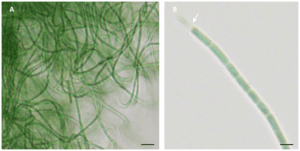
Morphological analysis revealed thin green filaments without heterocytes, often tangled, and rarely straight or solitary (Figure 1A), surrounded by a thin, colorless sheath with the presence of polysaccharides (Figure 1B).
The species also prefers very low light intensity, a trait related to its distribution within microbial biofilms found on the surface of maturing mud. ETS-13 grows in thick microbial mats where shading is caused both by other microorganisms and by the turbidity of the thermal water layer.
The species has an optimal growth temperature around 50 °C, as also confirmed by next generation sequencing analyses conducted by Gris et al. 2020 and Caichiolo et al. 2024. In NGS studies, ETS-13 was identified both in clays sampled from thermal ponds/lakes and in mature mud collected from various spas in the Euganean District.
Phylogenetic analyses indicated a close relationship with other species originating from thermal environments such as hot springs in Greenland, China, and Yellowstone National Park (USA).
One of the most interesting discoveries is ETS-13’s ability to produce chlorophyll f, a rare photosynthetic pigment that allows the organism to utilize infrared light for photosynthesis. This process, known as Far-Red Light Photoacclimation (FaRLiP), enables the cyanobacterium to survive even under very low levels of visible light, such as in the deeper layers of biofilms.
Currently, Kovacikia euganea ETS-13 is being cultivated and preserved in the strain collection of the Plant Genome Editing and Phenotyping Facility at the Department of Biology, University of Padua, on behalf of the Pietro d’Abano Thermal Studies Center.
This record is the result of a long-standing collaboration with the Department of Biology of the University of Padua and is part of the Digital Archive of the Pietro d’Abano Thermal Studies Center, created with the support of the Municipality of Montegrotto Terme (Municipal Council Resolution No. 121 of 17 July 2025).