


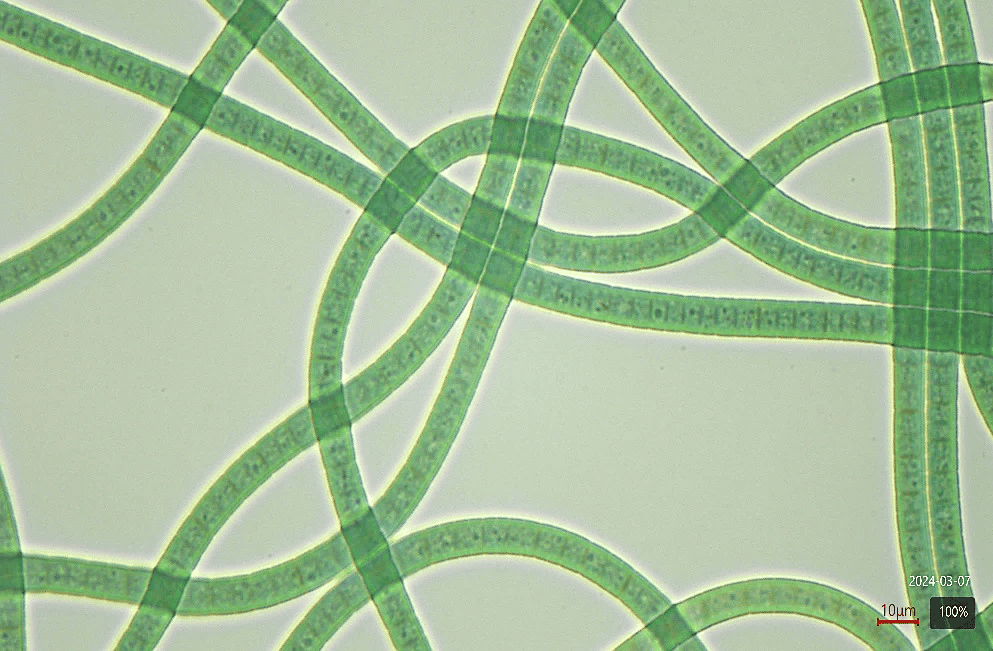
Phormidium sp. ETS-05
Phormidium sp. ETS-05 is one of the first thermotolerant cyanobacteria isolated from the thermal muds of the Euganean Thermal District. The strain was described by Ceschi Berrini et al. in 2004 based on morphological and molecular characteristics.
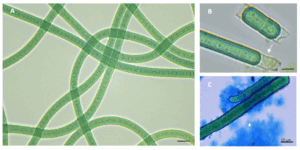
A livello morfologico (Figura 1 A), la specie si presenta con tricomi Morphologically (Figure 1A), this species appears as solitary trichomes (filaments) surrounded by a thin polysaccharide sheath, as shown in Figures 1B and 1C. The presence of a polysaccharide matrix (EPS) was also observed in culture through Alcian blue staining (Figure 1C).
Genetic analysis proved to be complex, and only by combining morpho-physiological and molecular studies was it possible to define ETS-05 as a specific ecotype of the Euganean Thermal District.
Cell size, the presence of a sheath surrounding the filaments, and ecological traits—such as the optimal growth temperature—clearly distinguished Phormidium sp. ETS-05 from other organisms, despite high levels of molecular identity. Its genetic sequence (16S rDNA gene) is registered in international databases, along with the complete genome sequence obtained by Gris and collaborators in 2020 (AJ548503.1; CP051168).
Recent studies based on next generation sequencing (Gris et al. 2020; Caichiolo et al. 2024) have confirmed its presence in both mature thermal muds and in clays from thermal ponds and lakes, with high abundance within the 37–47 °C temperature range.
Phormidium sp. ETS-05 is now considered the key species in the maturation of Euganean thermal mud. At 40 °C—the reference temperature for obtaining the “Fango Maturo DOC” certification—it is the most abundant organism and is supported by numerous studies confirming the therapeutic potential of the biomolecules it produces.
In culture, ETS-05 produces glyco- and sulfoglycolipids with anti-inflammatory properties, previously tested both in vitro and in vivo. These studies (Marcolongo et al. 2006; Bruno et al. 2005; Lenti et al. 2009; Ulivi et al. 2011) led to Italian Patent No. 0001355006 (2010) and European Patent No. 1571203 (2013), which certify its therapeutic efficacy and justify the classification of thermal mud as a natural medicinal product used to treat rheumatic diseases.
Since 2018, various studies have been conducted in the laboratories of Professors Nicoletta La Rocca and Luisa Dalla Valle (Department of Biology, University of Padua), focusing on the production and extraction of biomolecules either from laboratory-grown ETS-05 or from therapeutic muds with high ETS-05 abundance. These studies also included toxicological and anti-inflammatory testing in vivo, using zebrafish as a model organism.
More recently, the lipidic molecules were also investigated in the PhD thesis of Micol Caichiolo (2025), particularly building on the findings of Zampieri et al. (2023, 2025), who optimized cultivation conditions and showed that the species’ optimal growth temperatures are 40 °C and 50 °C, respectively.
In addition, the biochemical properties of polysaccharides extracted from Phormidium sp. ETS-05, and directly from therapeutic thermal muds, have been thoroughly studied (Zampieri et al. 2020; Zampieri et al. 2022; Caichiolo et al. 2024). These studies demonstrated the strong therapeutic efficacy of these newly identified bioactive molecules (for more details, see the Research Activities section).
Currently, Phormidium sp. ETS-05 is being cultivated and preserved at the Strain Collection of the Plant Genome Editing and Phenotyping Facility of the Department of Biology, University of Padua, on behalf of the Centro Studi Termali Pietro d’Abano.
This record is the result of a long-term collaboration with the Department of Biology, University of Padua, and is part of the Digital Archive of the Centro Studi Termali Pietro d’Abano, created with the support of the Municipality of Montegrotto Terme (Municipal Council Resolution No. 121 of July 17, 2025).